
Functional Neurological Disorder (FND) is a neurological condition in which a person experiences genuine neurological symptoms caused by changes in how the nervous system functions, rather than by structural damage to the nervous system.
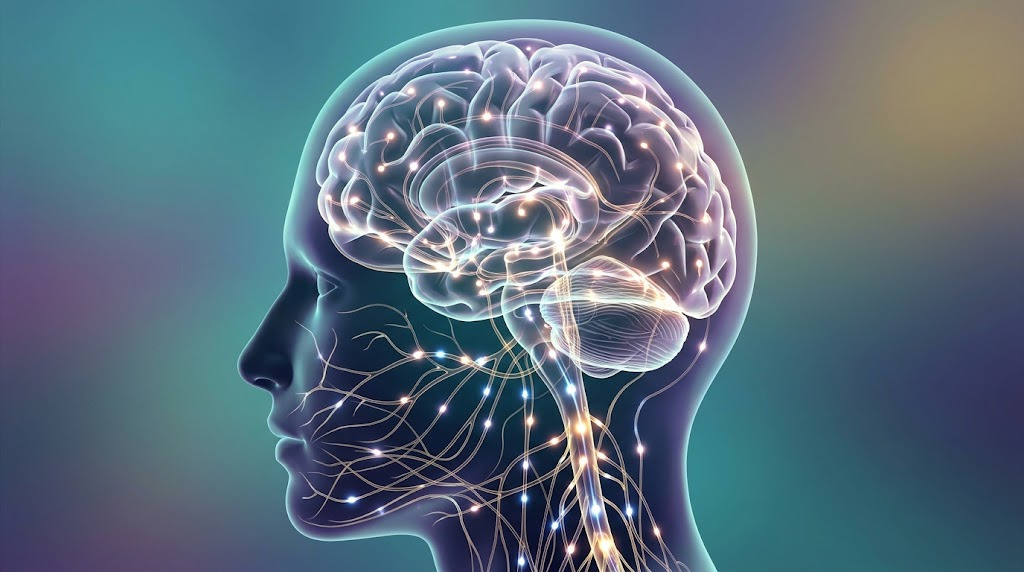
FND can present with a wide range of neurological symptoms. Importantly, it is not diagnosed simply because brain scans are normal. Modern diagnosis is based on positive clinical signs showing that the nervous system is not functioning in its usual way.
This does not mean that the symptoms are imagined, psychological, or “all in the person's head.”
The symptoms are real.
The difficulty lies in how the brain and nervous system communicate and coordinate information, rather than necessarily in a structural lesion that can be seen on a scan.
Symptoms may fluctuate and can sometimes become more noticeable during periods of stress or increased nervous-system arousal.
One way of understanding FND is to imagine the brain and nervous system as an
orchestra.
The musicians and their instruments may be perfectly capable of producing beautiful music, yet the performance can become disorganised when communication and coordination between the musicians and the conductor become unreliable.
The conductor has not disappeared.
The musicians have not forgotten how to play.
The instruments are not necessarily broken.
The problem is with coordination.
In a similar way, FND is increasingly understood in terms of altered communication between brain networks and changes in the way the brain processes and predicts sensory information.
The brain does not simply wait for information to arrive from the body. It is constantly making predictions about what it expects to experience and comparing these predictions with incoming information.
For example, when reaching for a cup, the brain predicts where the hand should move and how much force will be needed. It then compares this prediction with information from the body and the environment and adjusts the response.
This process normally works remarkably well. However, when the balance between prediction, attention, and incoming sensory information becomes disrupted, the brain's interpretation of what is happening in the body can become less accurate or flexible.
This helps explain how a person can experience a very real neurological symptom without structural damage being present.
The nervous system is also influenced by stress, illness, injury, pain, and overwhelming experiences.
Importantly, not everyone with FND has experienced trauma, and FND should not be assumed to be caused by trauma.
For some individuals, however, previous experiences of threat may contribute to a nervous system that becomes particularly alert or protective.
Returning to our orchestra metaphor, an orchestra that has learned to expect danger may become excessively vigilant. One section may become louder and louder while the others struggle to maintain their normal rhythm.
Similarly, the nervous system can become biased towards protection. A present-day situation may activate patterns learned during an earlier period of threat, even when the current circumstances are different.
The nervous system may respond as though:
“Something is wrong. I need to protect you.”
This may contribute to increased arousal, avoidance, freezing, dissociation or other protective responses.
The important point is that the nervous system is not deliberately producing the symptom. It is attempting to protect the individual, but the protective response may no longer be well matched to the present situation.

Perhaps the simplest way to understand FND is this:
The orchestra is still capable of making beautiful music.
The instruments have not necessarily been damaged, and the musicians have not lost their ability.
But the communication and coordination within the orchestra have become unreliable.
Treatment therefore does not simply focus on finding something that is “broken.” Instead, it aims to help the nervous system relearn flexibility, improve communication between networks, and develop a greater sense of safety and control over movement, sensation and bodily experiences.
Understanding the relationship between the brain, body, stress responses, and learned patterns can therefore be an important part of working with FND.
In the next article, we will explore treatment approaches used in FND and how the nervous system can begin to relearn more adaptive patterns of functioning.

